
Sensors › Motion Sensors › Motion Sensor – AIM
SENSORS
Motion Sensor – AIM
Our own inertial measurement technology, built on several IMUs rather than one.
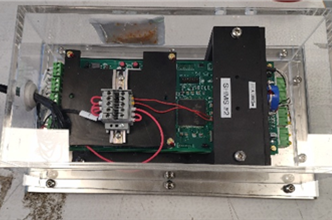
AIM — Advanced Inertial Measurement — is WISE Group’s embedded measurement and processing technology for motion. It is supplied within selected sensors and systems rather than as something you integrate yourself, and on a helideck it takes the form of a motion reference unit reporting all six degrees of freedom.
How it works
AIM is built on MEMS technology — micro-electromechanical systems — and digital inertial measurement units. An IMU combines accelerometers, rate gyros and magnetometers in one small package, and over the past two decades these have become both accurate and affordable.
What distinguishes AIM is that it uses several of them rather than one. Combining multiple IMUs, separated in space, improves accuracy beyond what a single unit gives, keeps measurement continuous across a wider dynamic range, and allows motions to be told apart that a single sensor would merge into one signal. A unit on its own cannot always distinguish a rotation about a distant centre from a translation at the sensor; units a known distance apart see the two differently.
What it reports
AIM reports all six degrees of freedom — surge, sway and heave, roll, pitch and yaw — together with the values derived from them and from the rates and accelerations behind them: heave rate, deck inclination, trim, list, and the severity indices that operations work to.
Some of those are measured directly and some computed, either in the unit or in the system behind it. Where that processing happens is part of the specification rather than an implementation detail, because it decides what a replacement sensor would have to reproduce.
Interfaces
Alongside the inertial measurement, AIM provides analogue signal interfacing, RS232 and RS485 serial, and RJ45 Ethernet, so the data reaches the system it belongs to without an intermediate converter. That matters most on a retrofit, where the receiving system is already in place and most of the work of adding a sensor is the work of getting its output to the right place in the right form.
Configured to the installation
Different platforms move differently, and a configuration tuned for one measures another poorly. Measurement range and sampling rate are set against the installation rather than taken from a default — the general principle is covered under motion sensors; in AIM’s case the settings are established when the unit is configured for the vessel or structure it is going to.
Placement matters as much as configuration. A motion sensor measures the motion at the point where it is bolted down, so a unit mounted away from the helideck reports something other than the deck.
Hazardous areas
AIM is supplied in a safe-area version and in an Ex d rated version, for installations where the mounting point sits inside a classified zone. The measurement is the same in both; the enclosure is not, and which one is needed is settled at specification rather than changed afterwards.
Where AIM is used
As a helideck motion reference unit, AIM provides the deck-motion data behind CAP 437 status reporting. The same technology is embedded in our AIM Wave Buoy Sensor, where buoy motion is processed into wave parameters, and within several WISE Group systems — including helideck monitoring, vessel motion monitoring and structural health monitoring.
Supplied as
The AIM-3 helideck motion reference unit, in safe-area and hazardous-area versions.
WISE AIM-3 — safe area
Helideck motion reference unit measuring six degrees of freedom — pitch, roll, heave, surge, sway and yaw — providing deck-motion data for CAP 437 helideck status reporting and motion correction. For safe-area installations.
WISE AIM-3 — Ex d
The same six-degree-of-freedom helideck motion reference unit, Ex d rated for hazardous areas, where the deck sits inside a classified zone.
Related
For the wider picture — inclinometers, third-party motion reference units, and how an instrument is matched to the motion it has to measure — see motion sensors. The buoy-mounted version of the same technology is on the AIM Wave Buoy Sensor page, and the technology itself under AIM embedded measurement technology. See all sensor types.
Download the datasheet
Specifications for the AIM-3 are in the datasheet: AIM-3 datasheet (PDF).
For anything it does not answer — configuration for a particular vessel or structure, Ex requirements, or integration with a system already installed — talk to us.