
Sensors › Motion Sensors
SENSORS
Motion Sensors
How much a deck, a hull or a structure is actually moving, across six degrees of freedom.
A helideck on a floating rig or vessel is a moving target, and a pilot needs to know how much it is moving before committing to land — which is why deck motion is reduced to a single severity index under CAP 437 rather than left as six separate figures. The same measurements tell a crew how a deck will behave for a lift, a transfer, or a rising sea state.
What a motion sensor measures
Motion is described by six degrees of freedom: three translations — surge, sway and heave — and three rotations — roll, pitch and yaw. Everything else is derived from those and from the rates and accelerations behind them: helideck heave and inclination, heave rate, trim, list, and the severity indices that operations actually work to.
Some values are measured directly; others are computed, either in the sensor or in the software behind it. Which parameters you need decides the class of instrument — and so does the motion itself. An FPSO moves slowly with long periods; a small work vessel moves quickly with short ones. A sensor set up for one is a poor fit for the other.
Inclinometers and motion reference units
Inclinometers measure pitch and roll only — the electronic descendant of the bubble on the bulkhead, resolving fractions of a degree, with a display or software behind it for graphical and historical presentation.
Motion reference units (MRUs) measure at minimum pitch, roll and heave, and extend to the full six degrees of freedom. They can track the motion of a whole vessel, or be dedicated to a helideck where the deck’s own motion is what matters.
What matters offshore
- Range and frequency. A sensor has to resolve the motion it is pointed at. Too coarse and small movements disappear; too narrow a range and heavy weather saturates it. Both the measurement range and the sampling rate are chosen against the installation, not the catalogue.
- Placement. A motion sensor measures the motion at the point where it is bolted down. Mount it away from the helideck and it reports something else — a rotation about a distant centre reads as translation at the sensor. Getting the position right matters as much as choosing the instrument.
- Hazardous area. Where the mounting point sits inside a classified zone, an Ex d rated unit is required. Helideck and vessel MRUs are generally available in both safe-area and hazardous-area versions, and which one you need is settled at specification rather than retrofitted afterwards.
- Integration. Motion feeds the helideck display, the vessel motion record and, where required, CAP 437 reporting. A third-party MRU already fitted can usually be brought into the same system through a signal and software interface rather than replaced.
Our own motion sensor
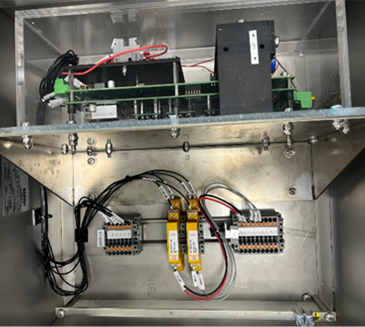
Alongside the third-party units we supply, we make our own. AIM — Advanced Inertial Measurement — is supplied as a helideck motion reference unit and embedded within several of our systems. How it works, what it reports, how it is configured and how it integrates are covered on the Motion Sensor – AIM page.
Examples from our range
A few of the motion sensors we specify, install, integrate and maintain. We supply more types and variants than are listed here.
WISE AIM-3 Helideck MRU
Our own helideck motion reference unit, measuring six degrees of freedom — pitch, roll, heave, surge, sway and yaw — and providing the deck-motion data behind CAP 437 status reporting. Supplied in safe-area and Ex d versions.
NORSUB MRU 3000 Marine
A marine motion reference unit measuring roll, pitch, heave and heading, for helideck and vessel-motion monitoring where a third-party MRU is preferred or already specified.
Related
Deck motion is reported alongside the rest of the weather in a helideck monitoring system, and tracked over time by a vessel motion monitoring system. Our own motion sensor is covered in detail on the Motion Sensor – AIM page. See all sensor types.